What's Happening at Wakodahatchee Wetlands Before the Winter Crowds
The spring photos from Wakodahatchee Wetlands show wood stork chicks, and those photos are what fill the parking lot on Jog Road. The nesting behind them starts earlier. In past seasons, field notes from the boardwalk have recorded wood storks and great egrets showing up more often by late November, and great blue herons claiming nest sites and cormorants feeding chicks by late December. For anyone in west Delray who lives a few minutes from 13270 South Jog Road, the early-winter weeks have been the stretch to see the colony being built, before the late-winter visitors arrive for the finished version.
Palm Beach County's own guidance is broad. Its Wakodahatchee page says different birds nest at different times of year, with the most nests "from later winter to early summer." The county names wood storks, egrets, glossy ibis, great blue herons, purple martins, common gallinules and black-bellied whistling ducks as the site's known nesters.
Field notes from regular visitors show activity beginning in the weeks before that peak. In a November 24, 2024 post on Birder's Journey, the writer noted great egrets and wood storks appearing more often at Wakodahatchee as breeding season approached. A late-December field note from the same blog found great blue herons staking out new nesting spots, anhingas, white ibises and yellow-crowned night herons in the trees, and cormorant chicks already begging for food.
In that year, some families on the islands already had chicks by the end of December while others were still choosing where to build.
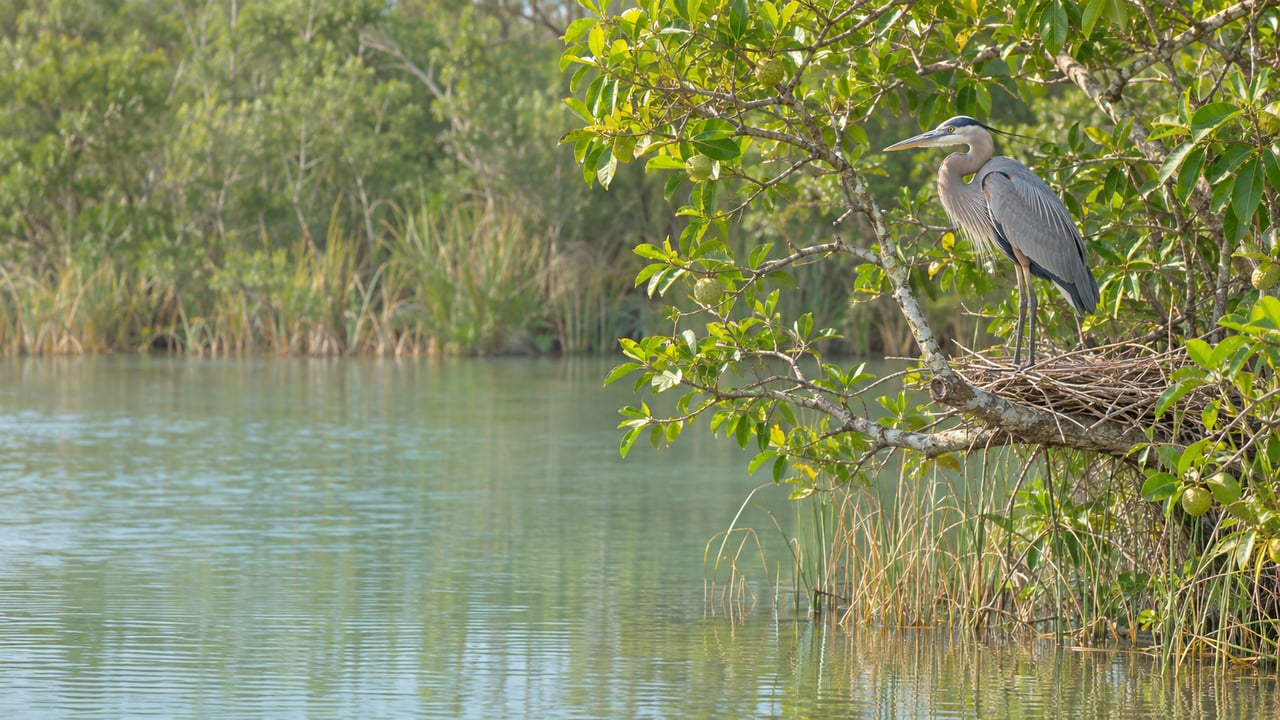
The great blue heron is the bird to watch in the early weeks. Wildlife photographer Ronen Tivony, writing in January 2026 on Wildlife with Ronen, describes great blue heron courtship at Wakodahatchee as peaking from January through April and calls winter a prime window for nesting activity.
Courtship and site selection come before the chicks, so a walk in early winter can show a heron working on a spot that will hold a nest weeks later. On a later walk, the same tree island shows the next stage. The boardwalk is a ¾-mile partial loop, with one entrance and exit near the parking lot and more than half the route forming a loop. That is short enough to walk on a weekday morning and come back the next week to check on the same island.
Wood storks are the birds that make the spring crowds. In a March 2025 visit, Florida Rambler counted dozens of visible wood stork pairs and found the colony active into at least mid-April. On March 1 of that year, the writer saw no hatchlings yet. The same report places a favored wood stork island about 15 feet from the boardwalk, beside a shaded shelter and bench, with nesting anhingas, cormorants, tricolored herons and great blue herons alongside the storks.
A few weeks later, Friends of the Everglades photographed a wood stork hatchling and anhinga chicks at Wakodahatchee on March 25, 2025, along with active anhinga and glossy ibis nests.
Across the region, the start date moves from year to year. The South Florida Water Management District's 2022–2023 wading bird report recorded wood stork egg laying in South Florida beginning in mid-February in 2022 and late January in 2023. Its restoration target is November through December. Those figures cover South Florida as a whole, not this one wetland. They still help explain the pattern at Wakodahatchee: wood storks seen around the ponds in early winter come well before the chicks, which have usually appeared in late winter or spring.
The county says plainly when the lot gets tight. Wakodahatchee has no overflow parking, and the lot "may become full during the day, especially from late winter to early spring." When it fills, on-site security directs cars to open spaces, and the county asks drivers to wait rather than drive past security. The county does not track wait times.
Living nearby helps in two ways. First, the early season falls before that rush. Second, the county runs three live cameras on the wetland, named Cooper's Hawkeye, Heron Creek and Egret Point, and suggests checking them for weather and boardwalk crowds before you leave. If you live off Jog Road or Lyons Road, you can check the cameras from home in the morning and go when the boardwalk looks quiet.
The basics are the same all year. Admission and parking are free, and the posted hours are 6:00 a.m. to 7:00 p.m. daily. The county prohibits pets, drones, tripods, boom mics, articulated camera arms, food, alcohol, jogging or speed walking, biking, skating, smoking and fishing. Photographers should plan on a lens they can hand-hold. Restrooms and a water refill station are by the parking lot, opposite the boardwalk entrance. Once you are on the boardwalk, there is no other water. Much of the walk is in full sun, with shade only at the gazebos and under some trees.
Wakodahatchee started as a utility project. Palm Beach County Water Utilities built it in 1996 next to its System 3 Water Treatment Plant, turning about 65 acres of former percolation ponds into wetland habitat. The name comes from a Seminole phrase meaning "created waters." Highly treated reclaimed water keeps the wetland wet, and the soil and sand underneath filter it further.
In October 2026, the county Parks and Recreation Department signed a Memorandum of Understanding with Water Utilities to take over ongoing management and maintenance of the boardwalk. The county's FAQ says the boardwalk normally gets an annual maintenance closure in October or November, posted in advance on its website, and the county's park page is where that notice will appear.
The county points drivers who can't wait for a space at Wakodahatchee to Green Cay Nature Center and Wetlands, at 12800 Hagen Ranch Road in Boynton Beach. Green Cay has triple the parking, a similar elevated boardwalk over a constructed wetland, and an indoor nature center. Wakodahatchee has none of those buildings.
Green Cay also has the programming that Wakodahatchee does not. On Saturday, December 5, from 9:00 a.m. to 3:00 p.m., Green Cay holds its free Wildlife Celebration, an all-ages event about South Florida's migratory animals with exhibitors, demonstrations and free tours, and no reservation needed. The Palm Beach County Beekeepers Association plans to bring an observation hive and offer local honey tastings and sales. The same calendar lists a Night Stalkers walk at 6:00 p.m. on Wednesday, November 25, a bird-migration talk and tour on Saturday, December 26, and another Night Stalkers walk on Wednesday, December 30.
The bigger change at Green Cay comes next year. The county's Green Cay Phase II project, approved unanimously by the county commission on December 19, 2023, is slated to open in early 2027. It includes a planned 63-acre Green Cay Nature Park at the southwest corner of Jog Road and Flavor Pict Road, with hiking trails and a boardwalk extension that will connect it to the existing Green Cay Wetlands as one walk. Parking at the current wetlands stays the same, and a new lot will open on Flavor Pict Road. The same project adds the Todd J. Bonlarron Green Cay Learning Center at the Southern Region Water Reclamation Facility on Hagen Ranch Road, open to school and visitor groups by advance registration. All Phase II sites stay closed to the public until construction is finished. The existing Green Cay Nature Center is keeping its usual hours and programs in the meantime.
Phase II also ties Green Cay back to Wakodahatchee's origin. Like Wakodahatchee, the new park is built around water the county treats and returns to the ground. The Phase II facility will purify reclaimed water to drinking-water quality and send it into lakes that recharge groundwater, and the county calls it the first project of its kind in Florida. If the county's early-2027 schedule holds, by the time wood storks are nesting next spring the stretch of Jog Road between the two sites could have a third place to walk.
The county runs no regularly scheduled programs at Wakodahatchee. Audubon Everglades fills that gap with guided Wakodahatchee walks from 9:00 to 11:00 a.m. on February 13, 2027 and March 13, 2027. Registration is required, and nonmembers pay $5 for the program. Entry to the wetland itself stays free. Both dates fall in the late-winter stretch when the county says the lot fills most often and past seasons have shown the wood stork colony at its busiest. A walk on your own in December, followed by a guided walk in February, covers the season from site selection to chicks.
At Boca Delray Properties, we enjoy sharing the places that make west Delray Beach feel like home, from the Heron Creek camera to the Saturday events at Green Cay. If you're weighing a move along the Jog Road corridor or comparing it with homes east of I-95, our guide to east and west Delray Beach homes is a good place to start. When you're ready, Let's Connect.
Whether you’re buying your first home, relocating, or selling your property for top dollar, Dina is committed to guiding you every step of the way. Her clients consistently praise her for being responsive, honest, and hands-on throughout the entire process.