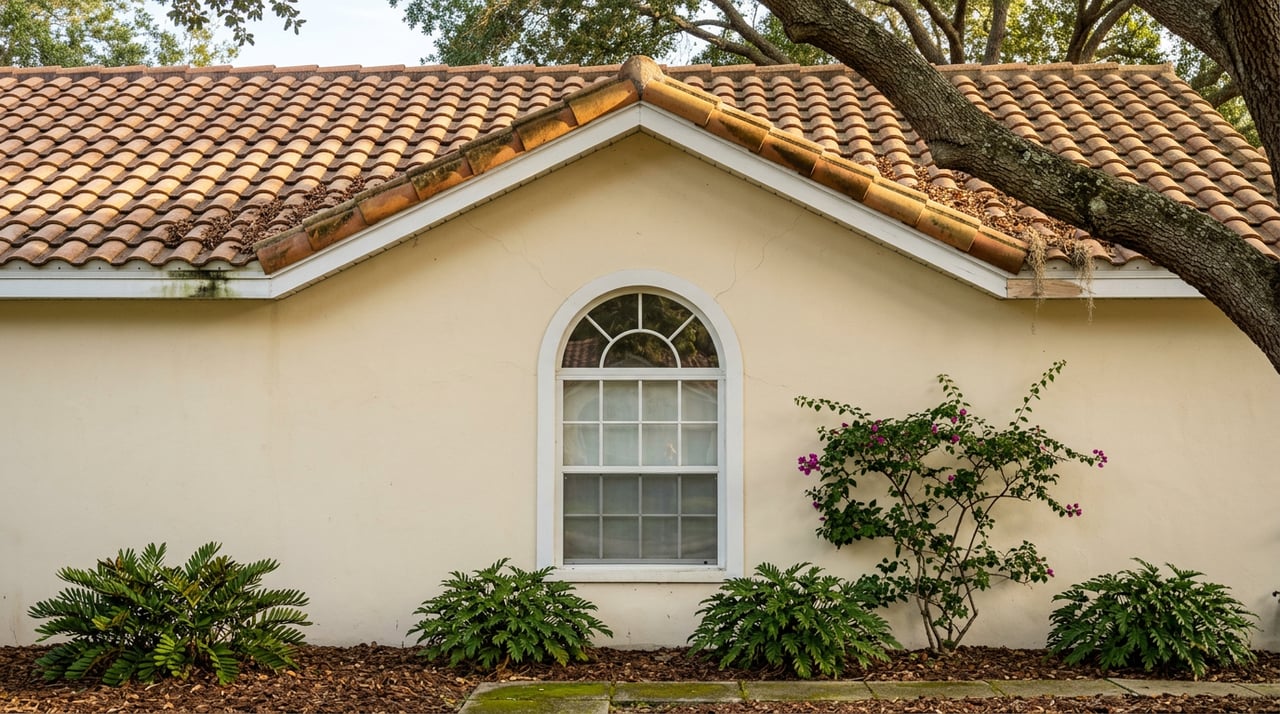
Roof and Preservation Steps for Historic Homes in Delray Beach
Planning a roof project in Del-Ida Park or the Old School Square Historic Arts District can involve two separate review timelines: one for insurance and one for the city.
The first clock belongs to the insurance company. Under Florida Statute 627.7011, an insurer cannot deny or non-renew a policy solely because a roof is under 15 years old. Once a roof crosses that line, the carrier can require a professional inspection; 4-point.info says an insurer can decline to write or renew coverage if the inspection shows fewer than five years of remaining useful life. Most carriers also require a full 4-point inspection, covering roof, electrical, plumbing, and HVAC, once a home passes 20 years old. Citizens Property Insurance, the state's insurer of last resort, confirmed in its own underwriting guidance updated this year that new-business submissions trigger this requirement past that 20-year mark.
The second clock belongs to the city. Any exterior alteration to a property inside one of Delray Beach's five historic districts, including a re-roof, generally requires review under a Certificate of Appropriateness before a building permit is even issued. For a single-family home, that review goes to city preservation staff or the Historic Preservation Board depending on scope. It exists to confirm the work keeps the district looking like the district. It also adds a step that a standard reroof in a non-designated neighborhood never has to clear.
One detail sellers can plan for: by the city's own definition, a property qualifies as historic once it turns 50 years old. That means almost every contributing structure in Delray's designated districts cleared both the 15-year and 20-year insurance thresholds decades ago. A large share of Delray's newer, non-historic housing stock is only now sitting inside that 15-to-30-year risk window, according to a Delray-specific analysis from MM Roof Repair, a roofing contractor that has worked in the city since 1970. A historic-district home has long been subject to those insurance requirements. The question for a seller is rarely whether the roof will get scrutinized. It is whether the paperwork already exists, and if it doesn't, how long it takes to generate it in the right order.
Delray Beach established its first historic districts in 1987, working with the Delray Beach Historical Society and a group of volunteer citizens, according to the Historical Society's own account. A fifth district, West Settlers, followed in 1997, preserving the site of the city's first African American settlement, established in 1894 by families who arrived from northern and western Florida, Georgia, and South Carolina and who built a school, three churches, and a Masonic Lodge between 1895 and 1920.
| District | Character | Scale |
|---|---|---|
| Old School Square Historic Arts District | Delray's largest, sitting at the original town center; frame vernacular, masonry vernacular, and Craftsman bungalow styles dating 1902 to 1945; includes Banker's Row, the Cathcart House on South Swinton Avenue, and the Sundy House | 176 structures, 101 contributing |
| Del-Ida Park | Platted in 1923 with a diagonal street pattern and curvilinear corners forming triangular blocks; Mediterranean Revival and Craftsman Bungalow styles | 58 acres, 151 structures, 47 contributing |
| Nassau Park | The city's first planned residential development south of Atlantic Avenue; one- and two-story Cape Cod Colonial Revival cottages | 17 cottages |
| Marina Historic District | Built around the city marina on the Intracoastal Waterway; Streamline Moderne, Colonial Revival, Mediterranean Revival, and bungalow styles on narrow, shaded streets | Delray's most pedestrian-oriented district |
| West Settlers | Originally called "the Sands," the site of Delray's first African American settlement | 53 structures, 23 historic |
Every one of these homes, if it contributes to its district, is old enough that its roof has almost certainly needed at least one certification cycle already. That is not a warning. It is simply the operating condition a seller needs to plan around.
The instinct when a roof fails a 4-point inspection is to tear it off and start over. In these districts, that instinct is expensive and often unnecessary. A full tile roof replacement in Palm Beach County runs $35,000 to $75,000 or more depending on home size, tile type, and structural work, according to pricing shared by MM Roof Repair in its March 2026 analysis of Delray's roof age exposure. On most of the city's older tile roofs, the tile itself still has decades of life left. It is the underlayment beneath it, degraded by sun and heat, that actually fails first. A targeted rebuild that reuses sound tile and replaces only the underlayment can reset the insurer's remaining-useful-life clock at a fraction of a full tear-off, while also preserving the original material a preservation board wants to see.
That distinction matters twice over here. A rebuild that keeps the existing clay barrel or concrete tile is more likely to sail through review as routine maintenance. A full replacement with different tile, color, or profile is an exterior alteration, and clay barrel tile common in the districts around Atlantic Avenue and Lake Ida carries added sourcing and labor cost specifically because matching a discontinued profile takes real work, according to one Palm Beach County roofing contractor's own cost breakdown. Get the roof certified before deciding which path you're on. A certification first can help inform the repair decision.
One more piece of paperwork sellers overlook: the city's own re-roof permit checklist requires an insurance summary sheet, recent tax bill, or improvement value documentation whenever a home was built before March 2002 and its improvement value tops $300,000. Nearly every historic-contributing home in Delray clears both conditions automatically, which means that document needs to be pulled before a permit application goes in, not after.
As of July 1, 2026, a new state law, Senate Bill 808, widened who is authorized to perform a roof certification. Previously the pool was narrower. Now licensed home inspectors, building code inspectors, general and residential contractors, professional engineers, and licensed architects can all issue the assessment an insurer needs to see. For a seller trying to get a certification scheduled quickly ahead of a listing, that is a real, current advantage. It did not exist a little over a month ago.
Delray Beach offers a Historic Property Ad Valorem Tax Exemption covering 100% of the assessed value of qualifying rehabilitation work, for up to 10 years, according to the city's own economic incentives page. If a property assessed at $100,000 receives $25,000 in qualifying, COA-approved improvements, that $25,000 stays untaxed for a decade. If the home sells during that window, the exemption transfers to the new owner. Federal historic tax credits, worth up to 20% of qualified rehabilitation costs, exist too, though those apply only to income-producing, non-owner-occupied properties within a national historic district.
A seller who completed COA-approved work in the past few years and never confirmed whether the exemption is active is leaving a transferable benefit on the table, unmentioned in the listing and unknown to the buyer's lender.
Does selling a historic home in Delray Beach require a Certificate of Appropriateness? No. The COA applies to exterior alterations, additions, or demolition work on a designated property, not to the sale itself. It only enters the picture if you're doing exterior work, including a re-roof, before or during the listing.
How do I know if my roof needs a full replacement or just a certified rebuild? A licensed inspector, and as of July 1, 2026 that now includes engineers and architects in addition to roofing contractors, can evaluate remaining useful life. On many of Delray's older tile roofs, the tile survives longer than the underlayment beneath it, which is why a rebuild is worth asking about before committing to a full tear-off.
What happens to a historic tax exemption if I sell while it's still active? It transfers to the new owner for whatever portion of the up-to-10-year term remains, according to the city's own program terms. Confirming this before closing lets both sides account for it correctly.
Selling in one of these districts rewards a seller who plans the sequence, not just the price. If you own a home in Del-Ida Park, Old School Square, Nassau Park, the Marina district, or West Settlers and want a clear read on where your roof and your paperwork actually stand before you list, Boca Delray Properties is a straightforward place to start that conversation. Let's Connect.
This article is general information, not legal, tax or financial advice. Consult a qualified professional about your situation.


Whether you’re buying your first home, relocating, or selling your property for top dollar, Dina is committed to guiding you every step of the way. Her clients consistently praise her for being responsive, honest, and hands-on throughout the entire process.